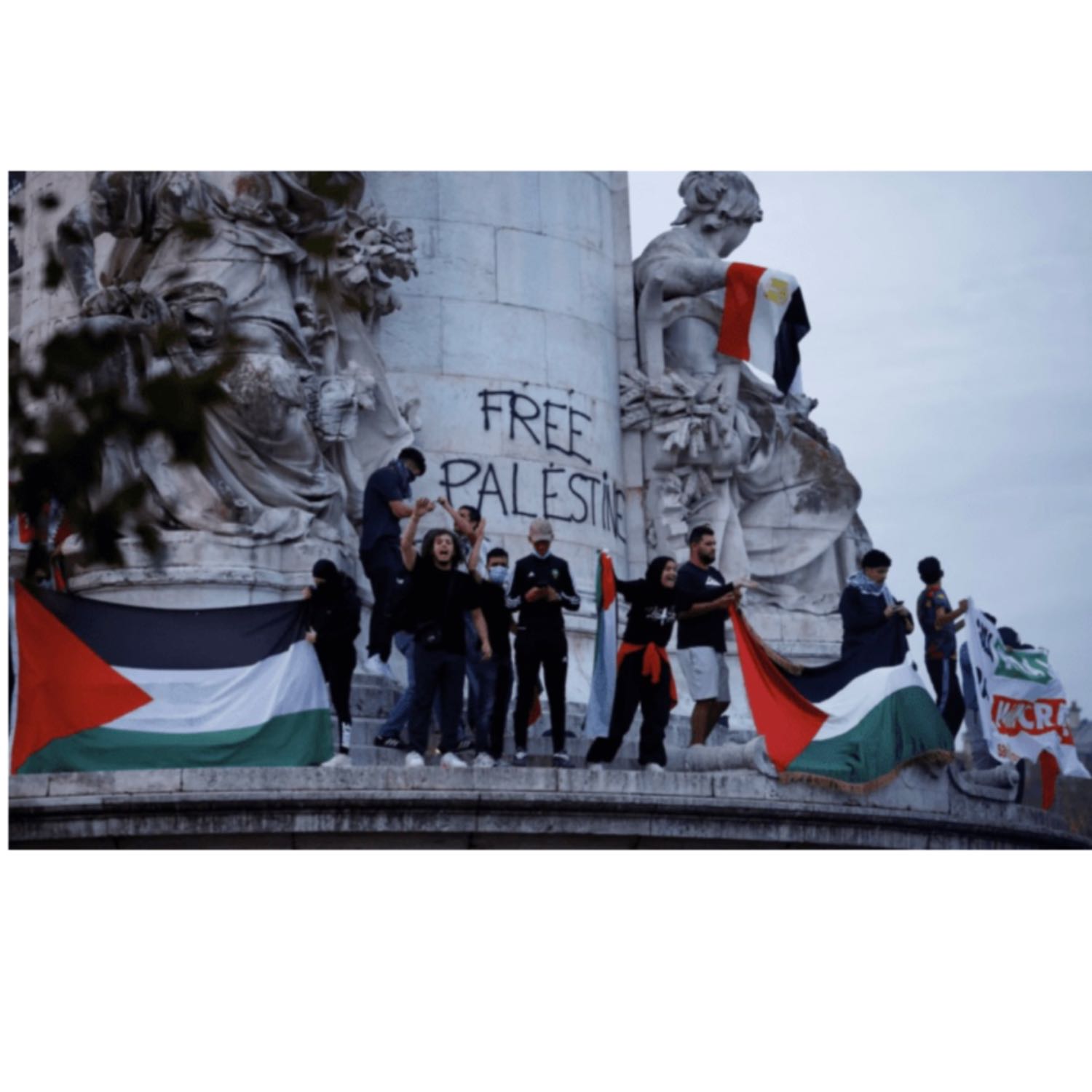
Hi, this is Ginevra with Mosaic, the channel putting pieces together. Today we're going to be talking about the situation in Gaza from the point of view of international law, in particular international humanitarian law. So it's not going to be a very easy episode and it's probably going to be a longer one. So if you're not up for the challenge, please leave now. I mean, not now, but just be prepared to do a little bit of a more intense episode. There are a couple of disclaimers I'd like to put out before I start. First one is that I will probably not be able to cover all the international law and international humanitarian law on this subject because it's huge. And second disclaimer, if we want to talk about international law within the Palestinian question, which should really actually talk about more than 100 years of history and even more so probably, but that's not possible. And so we will only focus on the war that has been going on in the last three weeks, almost a month, nearly. So let's try to dive in, into this very intricate subject. I will first try to give you a little bit of a general context of international humanitarian law. Then we will explore the difference between genocide crimes against humanities and war crimes. And lastly, if there's time, I'm going to be talking about some ways of possible accountability and the icc. So what is international humanitarian law? They are international rules that limit what is allowed during wars. So even though some forces, for example Israel or some Hamas officials, advocate for neglecting international law, international law, and in particular international humanitarian law, was created to put some limits to wars in order to not destroy entire areas of the world and entire peoples. These limits are fundamental so that conflicts can be somehow resolved rather than completely destroying areas of the world or people. International humanitarian law rules are recognized by the international community as jus cogens, which is the body of parentory norms that apply to every state legalese we say erga omnes and these rules cannot be derogated in any way. And that means that these rules apply to every single conflict, to every single state and non state actors, regardless of the fact that they signed treaties or not. And to these rules, some sort of principle of non reciprocity applies, which means that you can't break the rules just because you need to react to something that has been done to you. International humanitarian law applies to armed conflict. So we need to ask ourselves if the war in Gaza that has been going on for now, three weeks, almost a month, really is indeed an armed conflict. Personally, I'm Always very careful to defining this a war or a conflict, because I believe that one can speak of a conflict when there are two equal forces fighting each other. And in the case of Israel and Gaza, there are certainly not two equal forces fighting each other, but only an indiscriminate oppression of the Palestinian people by the State of Israel. So when I talk about these matters, I don't like to call it conflict or war. But at this point, I think we have to. There is indeed an armed conflict happening in Gaza at the moment. But when we say this, we must remember that hostilities didn't start on 10-6-7th. The conflict has been in place since at least 2006, and we've seen a lot of sparks of violence between 2006 and now between Hamas and the State of Israel. During these events, thousands of civilians were killed and they were almost all Palestinians with a few Israelis. And until now, no international accountability mechanism worked and nobody was punished. The Israeli army has been controlling what goes in and out of Gaza for a long time. It controls everything in Gaza, even the birth register. And in 2004, the ICJ defined Israel as an occupying power, while the Israeli government denied this for Gaza and the west bank, even if the occupation has lasted since 1967. But if we have a war, or rather a siege in Gaza, what is the international law that can be applied? There are the Hague Convention of 1907, the Geneva Conventions, customary armed conflict rules, which bind all states, irrespective of whether they're signed by states, and then there is the Rome Statute of the International Criminal Court, which we will see a little bit more about later. But now I want to give you a concrete example of how international humanitarian law works. A few days ago, the Israeli troops bombarded the Jabalia refugee camps. I apologize if I didn't pronounce this correctly. Anyways, they did that. And they publicly admitted that they bombarded the refugee camp because allegedly one Hamas leader was present there. According to Israeli officials, that was sufficient to authorize the bombardments, minimizing completely the civilian casualties, because they said that they warned them in advance to move south, but that possibly amounts to people transfers in international law. And also it's not legal to warn people to move somewhere else if there isn't actually anywhere they can move. And notably Gaza. Gaza is an open air prison and there's no way to escape it. So Israel claims that they need to get Hamas terrorists and leaders in the Gaza Strip and that they will do anything in their power to do that, even kill all the civilians but can you kill civilians to get to a military target? Before answering the question, let's give a little context. The only people living in Gaza are the descendants of refugees from the 1948 Nabka, which is when the State of Israel was created and many Palestinians were made refugees because they were evicted from their homes. Also, in less than a month, there have been more than 9,000 victims. To give you a little bit of a context here, when the United States bombed Iraq in the first nine months of the war, there were 12,000 civilian casualties. Now in Gaza, in less than a month, there are more than 9,000. So it's a complete tragedy, especially because nobody can escape Gaza. There is no safe place to go in Gaza. So the IDF justification that one target, one military commander, justified all those deaths in the Jabalya refugee camp is completely inadmissible in international law. Actually, that amounts to a textbook war crime, because international law prohibits attacks that are indiscriminate and not proportionate. Basically, there is a distinction in international law between civilians, civilian objects, and military personnel and objectives. And we have an indiscriminate attack when the attack is anticipated to hit civilians and military targets in the same way as if they were the same, which is illegal international humanitarian law, because of the distinction that I just mentioned, basically, you cannot hit civilians and civilian objects, otherwise it would be an indiscriminate attack. But because we're talking about war and it's not always possible to not cause harm to civilians, in international humanitarian law, we have the principle of proportionality. So before launching an attack or not launching an attack, a proportionality assessment must be made by the military forces. What they must do is to weight the incidental damage, the collateral damage that might injure the civilian population. And if the attack is assessed to cause too many casualties or hit too many civilian objects, then it cannot be done. Under these regulations, civilian casualties can never be excessive. So what is really horrible about this conflict happening in Gaza right now is the attempt to rewrite armed conflict law and justify indiscriminate attacks. At this point, I feel like I need to clarify that the attacks perpetrated by Hamas on October 7th are horrors. And they are war crimes as well, because their violence was directed towards unarmed civilians. And also it is always forbidden in international law to take hostages. And actually, taking hostages can also amount to a crime against humanity because it is a systematic attack against the civilian population. Both sides really are guilty of war crimes and crimes against humanities. Even just firing one shot against a civilian is a crime against humanity. I guess now is the perfect time to switch into the topic, into the difference between genocide, war crimes and crimes against humanity. Let's start with genocide, which is a very painful topic in international law, and we all know why. But genocide is defined by Article 6 of the Rome Status by a series of conducts that have in common the intention to destroy in whole or in part a national, ethnical, racial or religious group. So basically, it is using various conducts to subjecting people to conditions that result in the destruction of an entire people. There are many debates on whether the war in Gaza amounts to a genocide or not. But actually, to talk about genocide, we don't need to find the genocide in action, because the genocide convention of 1948, which was written to prevent the crime of genocide, states that there is an obligation to prevent genocides, to prevent the risks of a genocide happening again. And so in my opinion, we can totally talk about a genocidal conduct by the Israeli army in Gaza. Now, defining war crimes is a little bit more problematic because the Rome Statute of the ICC in Article 8 defines 54 prohibited conducts that amount to war crimes. They are in general serious violation happening in armed conflicts, like, for example, mistreatment of prisoners, prisoners of wars, denial of helps for civilians, disproportionate attacks, all things that the Israeli army is now doing in Gaza and then codified in Article 7 of the ICC Statute. We have the crimes against humanity which are defined as acts committed as part of a widespread or systematic attack directed against any civilian population with knowledge of the attack. And here too we have a list of problematic conducts. They have some things in common, but they are different than war crimes because they are committed as a systematic attack against the civilian population. And they are, for example, murder, extermination, rape, apartheid is also a crime against humanity and many other inhuman acts. And I encourage you to look at Article 7 to see the list. The problem here is that genocide, war crimes, crimes against humanity are being normalized by the State of Israel. It's in the language that they use. They're living figures literally saying that they want to extirpate, annihilate, burn to the ground, wipe off the face of the earth the Palestinian people. And that's a genocidal language that is very well leading to an actual genocide. And this has been going on for a while. To be frank, it has been years, if not decades, that Israeli government figures, sometimes they talk and they say that the Palestinian people don't even exist as a people. And saying the words that a national group does not exist is a paramount premise for its cancellation. This is why what's happening in Gaza is a genocide. Or is it not? Well, you can have a different opinion, obviously. I will leave you people to judge. Another organ that can judge on these crimes is the International Criminal Court. The problem with the ICC is that not everybody recognizes it. Not every state joined the Treaty of Rome and so the ICC may not have the jurisdiction to judge on crimes happening in that state. However, Palestine is a state party to the ICC and the prosecutor in 2021 declared that the ICC has the jurisdiction to investigate the situation in Palestine. And that extends to what happened on the 7th of October and in the following weeks. However, the Court has some instrument to act before the hostilities end too. I can't go into the specifics here because they're really techn but the ICC in theory can try individuals that are not nationals of states that ratify the Rome Statute. On the other hand, states that didn't ratify the Rome Statute are Russia, China, India and the United States. There has been a desire to strengthen the International Criminal Court and the Statute, but European states, despite being signatory parties, they have opposed it and the United States has opposed it even more. It is curious because about the situation in Ukraine. The United States has actually supported the Ukraine investigation financially, but with a very important caveat. They made very clear that none of the funds that they gave to the ICC could be used for the situation in Palestine, which in some ways is very similar to that in Ukraine, because in both situations their responsibility for international crimes comes from a non party state, which is Israel and Russia. Unfortunately, I am a very big supporter of the advancement of international criminal mechanisms, but behaviors like that actually unfortunately weaken the International Criminal Court and leave little hope that it will be actually meaningful in the future. The situation in Ukraine and the situation in Palestine under the Rome statutes are also similar because the ICC action in Ukraine and its jurisdiction in Ukraine was possible because Ukraine used Article 12 of the Rome Statute, accepting the Court's jurisdiction. And Palestine had made the same statement in 2009. So 15 years ago. So already 15 years ago, Palestine wanted an intervention of the International Criminal Court on what was happening on the occupied territories. But only in 2021 the judges spoke, declaring that the Court had jurisdiction over the situation in Palestine. I know you guys lots of stuff and I guarantee that on any of these concepts you can probably wr books and books, entire libraries of books. So it's very difficult for me to talk about it in 20 minutes or so. For those who were able to stick around thank you so, so much. I really appreciate you. And for those who didn't, I forgive you. I know that it takes much more than a simple podcast episode or writing an article or going to a demonstration to support Palestine right now. And if you can think of anything that I can do more, please do let me know. Really, thank you. Thank you for listening to this episode of Mosaico. Ciao for now.